
One Person Company (OPC) Registration in India: Eligibility, Process, Documents and Cost
If you're running a consulting business, professional practice, online store, freelancing operation, or another business on your own, you may eventually outgrow the simplicity of a proprietorship. At that stage, one person company registration can give you a formal corporate structure with a separate legal identity and limited liability, without requiring a second shareholder. The incorporation is handled through the Ministry of Corporate Affairs (MCA), primarily through the SPICe+ system.
An OPC is not automatically the right choice for every solo entrepreneur. You need to consider your business activity, future funding plans, compliance requirements, taxation, GST position, and whether you expect to add co-founders or investors. This guide explains the current OPC registration process in India, eligibility, documents, fees, compliance requirements, and the practical differences between an OPC and a sole proprietorship.
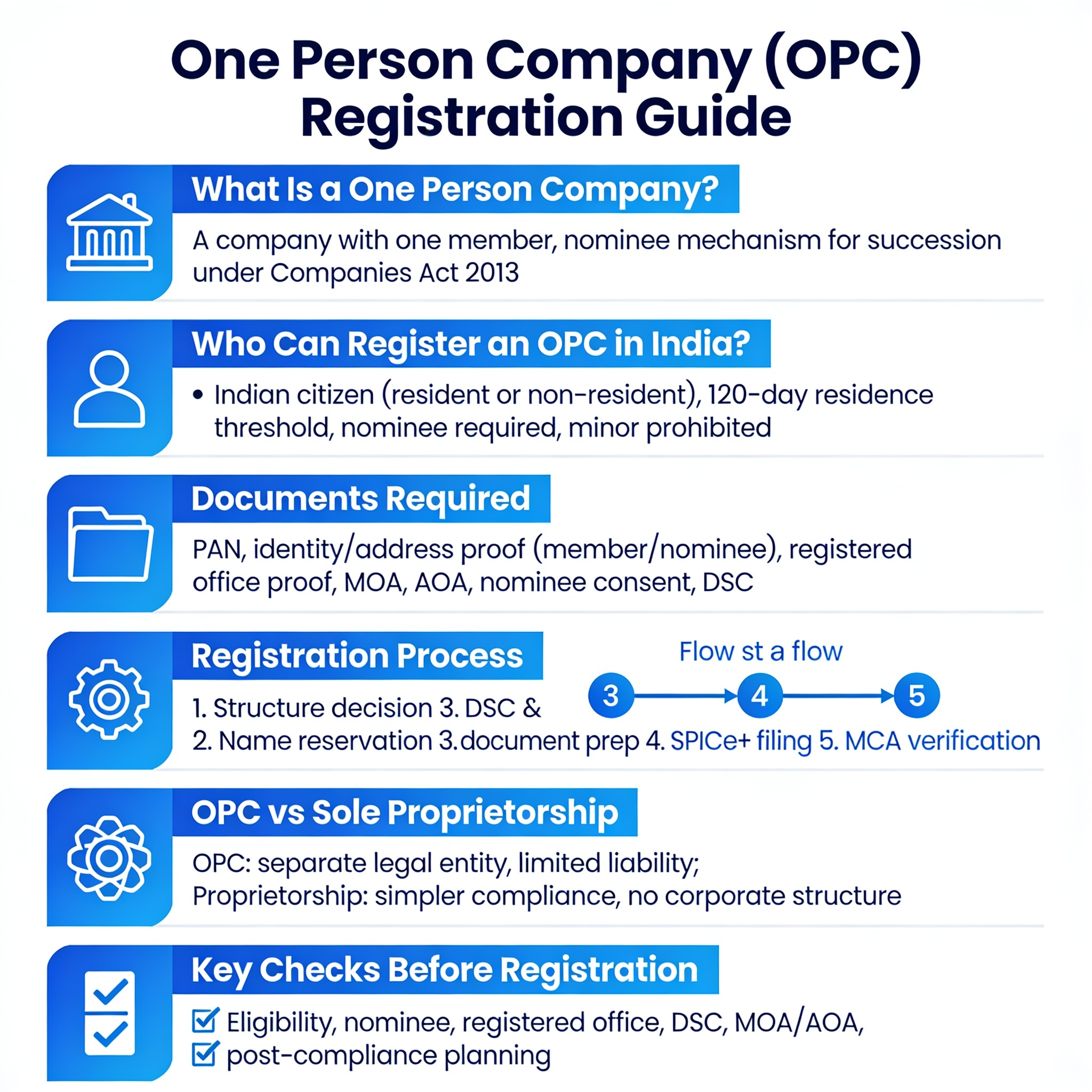
What Is a One Person Company?
A One Person Company (OPC) is a company that has only one member. It provides a single entrepreneur with a corporate form of business while maintaining a nominee mechanism for succession.
Under the Companies Act, 2013, the member must nominate another person who can become the member of the OPC if the original member dies or becomes incapable of entering into a contract. The nominee's written consent is required as part of the incorporation process.
This structure can work well for a solo founder who wants to separate the business from personal affairs and operate through a registered company.
Who Can Register an OPC in India?
An OPC can be incorporated by an eligible individual who is an Indian citizen. Since the 2021 amendment, an Indian citizen can incorporate an OPC whether resident in India or otherwise, subject to the applicable rules. The residence threshold used in the rules was also reduced from 182 days to 120 days.
Before starting one person company registration, check these basic conditions:
-
Only one individual can be the member of the OPC.
-
The member must be an eligible Indian citizen.
Need help with this? Talk to Chandwani & Company Chartered Accountants in Bhopal → -
A nominee must be appointed with the required consent.
-
A minor cannot be the member or nominee.
-
The proposed business activity must be legally permissible for an OPC.
-
An OPC cannot be incorporated as a Section 8 company.
-
Certain activities, including specified financial activities, are restricted.
One practical point deserves attention: choosing the nominee is not just a formality. The nominee should understand the role and be comfortable providing the required consent and documents.
What Documents Are Required for OPC Registration?
The documents for OPC registration generally cover the proposed member, nominee, registered office and incorporation documents. Preparing them correctly before filing can reduce the chances of resubmission.
You will generally need:
-
PAN of the proposed member
-
Identity and address proof of the member
-
Address and identity proof of the nominee
-
Passport-size photographs, where applicable
-
Proof of registered office
-
Recent utility bill of the registered office
-
No-objection certificate from the owner, where applicable
-
Memorandum of Association (MOA)
-
Articles of Association (AOA)
-
Nominee consent
-
Digital Signature Certificate (DSC), where applicable
MCA's SPICe+ guidance specifically includes identity and residential proof of the first subscriber, director and nominee, with nominee documents being applicable to OPC incorporation.
The registered office is a common source of avoidable problems. Make sure the address on the supporting documents is consistent and that you have the owner's consent where required.
How Does the OPC Registration Process Work?
The OPC registration process starts with confirming the business structure and proposed name, followed by preparation of the incorporation documents and filing through MCA's SPICe+ system.
Step 1: Decide whether OPC is the right structure
Before filing anything, compare OPC with a proprietorship, LLP and private limited company.
For example, if you're a freelancer with limited turnover and very few compliance requirements, a proprietorship may be simpler. If you're building a business that may eventually have investors or multiple shareholders, a private limited company may be more appropriate from the beginning.
Chandwani & Company provides company registration services covering different business structures, including private limited companies, LLPs, partnerships and proprietorships. This makes structure selection an important first step rather than something to decide after incorporation.
Step 2: Select and reserve the company name
The proposed company name needs to comply with MCA naming requirements and should be checked for similarity with existing company or LLP names and trademarks.
The name reservation and incorporation process is handled through MCA's electronic incorporation system. Current MCA filings operate through the V3 environment.
Don't select a name simply because the domain name is available. A domain, trademark and MCA company name are separate considerations.
Step 3: Obtain DSC and prepare the documents
The required Digital Signature Certificate and incorporation documents should be arranged before submitting the application.
At this stage, finalise the nominee, registered office, business activity, MOA and AOA. The business objects should accurately describe what the company intends to do.
This is one area where professional review can be valuable. A generic object clause may appear convenient during incorporation but can become inconvenient when the company later expands into activities that were not properly considered.
Step 4: File SPICe+ and linked forms
The incorporation application is filed through SPICe+ along with the applicable linked forms and supporting documents.
MCA's SPICe+ documentation provides for integrated services such as company incorporation, DIN allotment for eligible directors, PAN and TAN allocation and an optional GSTIN application.
For an OPC, nominee-related documentation must also be submitted as part of the incorporation process.
Step 5: MCA verification and incorporation
MCA reviews the submitted application and documents. If the application is approved, the company receives its Certificate of Incorporation and Corporate Identity Number (CIN).
The exact processing time cannot be guaranteed. It depends on factors such as name approval, document accuracy, MCA scrutiny and whether a resubmission is required.
How Much Does OPC Registration Cost in India?
There is no single fixed amount that applies to every OPC registration fees calculation. The total cost can include government filing fees, applicable state stamp duty, DSC charges and professional fees.
MCA's fee structure provides specific provisions for OPCs and small companies, and the applicable government fee depends on the filing and relevant capital structure.
Your overall cost may therefore include:
-
MCA government filing fees
-
Applicable stamp duty
-
DSC charges
-
Professional fees
-
Optional GST registration assistance
-
Accounting and compliance services after incorporation
Be careful with advertisements offering a single "all-inclusive" OPC registration price without explaining what is included. Government fees and professional charges are not always the same thing.
The bigger financial decision is often the annual compliance cost. An OPC may be suitable for a solo entrepreneur, but it is still a company and requires ongoing statutory and financial compliance.
OPC vs Sole Proprietorship: Which One Should You Choose?
OPC vs sole proprietorship is essentially a choice between a corporate structure and a simpler individual business structure.
An OPC provides a separate legal entity and limited liability framework, while a sole proprietorship is closely connected to the individual proprietor. A proprietorship is generally simpler to start and maintain, whereas an OPC involves additional company-law compliance.
An OPC may make more sense if:
-
You want a formal corporate identity.
-
You want a limited liability structure.
-
Your business is becoming more established.
-
You expect to hire employees or enter larger contracts.
-
You want the option to convert into another company structure later.
A proprietorship may be more suitable if you're testing a small business, working with limited risk, or want to keep compliance as simple as possible.
Chandwani's article on conversion from sole proprietorship to private limited company is also useful if your existing business is already moving beyond the proprietorship stage.
What Compliance Is Required After OPC Registration?
OPC registration is only the beginning. Once the company is incorporated, you need to maintain books of account, meet applicable annual filing requirements, manage tax obligations and complete other statutory compliances applicable to the company.
One important post-incorporation requirement is Form INC-20A, where applicable. It relates to the declaration for commencement of business and must be filed within the prescribed period after incorporation when the statutory conditions apply.
Chandwani & Company's recent guide on INC-20A filing and first auditor appointment after company incorporation provides additional context on these early compliance requirements.
GST is a separate consideration. Incorporating an OPC does not automatically mean that GST registration is mandatory in every case. GST applicability depends on the nature of supplies, turnover and other conditions under GST law.
If GST registration applies to your business, Chandwani & Company also provides GST Registration services for businesses, startups and professionals.
Can an OPC Be Converted Into a Private Limited Company?
Yes. An OPC can be converted into a private or public company by following the applicable Companies Act requirements.
The 2021 amendments removed the earlier mandatory conversion triggers based on ₹50 lakh paid-up capital and ₹2 crore average annual turnover. The amended rules also provide the conversion mechanism through the relevant MCA filing process.
This is useful for founders whose businesses grow beyond a one-member structure. However, if you already know that you will soon bring in co-founders or outside investors, starting with a private limited company may avoid a later restructuring exercise.
What Should You Check Before Starting OPC Registration?
Before submitting the incorporation application, work through these points:
-
Confirm that you are eligible to incorporate an OPC.
-
Decide whether OPC is better suited to your business than a proprietorship or another structure.
-
Finalise the proposed business activity.
-
Select a suitable company name.
-
Identify the nominee and obtain consent.
-
Verify the registered office documents.
-
Arrange DSC and identity/address proofs.
-
Review the MOA and AOA.
-
Submit SPICe+ and the applicable linked forms.
-
Plan post-incorporation accounting, tax and statutory compliance.
This sequence matters. Many founders focus only on getting the Certificate of Incorporation and think about compliance afterwards. A better approach is to consider the full lifecycle of the business before choosing the structure.
Is One Person Company Registration Right for You?
One person company registration can be a good option if you're operating independently but want the structure of a company rather than a proprietorship. It can provide a formal corporate identity and limited liability while allowing you to remain the sole member.
It may not be the best option if you expect to add investors or co-founders soon. In that situation, a private limited company may be more practical from the outset.
If you're uncertain, compare the structure, expected compliance, tax position, funding plans and long-term business model before filing. Chandwani & Company's Startup Advisory services can help founders evaluate business structuring, regulatory registrations, financial planning and tax compliance together.
Need Help With OPC Registration?
If you're ready to establish your business as an OPC, start by checking eligibility, nominee requirements, registered office documents and the proposed business activity. Getting these details right before filing can prevent avoidable resubmissions and future compliance issues.
Chandwani & Company assists entrepreneurs with company registration and related business compliance. If you're still deciding between an OPC, proprietorship, LLP or private limited company, professional guidance can help you choose the structure that fits your current business and future plans.
FAQs About One Person Company Registration
Can an NRI register an OPC in India?
Yes. The 2021 amendment changed the rules so that an Indian citizen can incorporate an OPC whether resident in India or otherwise, subject to the applicable conditions. The rules also changed the residence threshold from 182 days to 120 days.
What is the minimum capital required for an OPC?
The earlier mandatory thresholds linked to ₹50 lakh paid-up capital and ₹2 crore average annual turnover were removed through the 2021 amendments. Therefore, those thresholds should not be treated as current compulsory conversion triggers for OPCs.
Is a nominee compulsory for an OPC?
Yes. An OPC member is required to nominate another person with prior written consent. The nominee can become the member in specified circumstances, including the death or incapacity of the sole member. The nominee's consent forms part of the incorporation documentation.
Is GST registration compulsory for every OPC?
No. OPC incorporation and GST registration are separate requirements. GST registration depends on factors such as the nature of the business, taxable supplies, turnover and other conditions under GST law. You should evaluate GST applicability separately after deciding the business structure.
How long does OPC registration take?
There is no fixed guaranteed timeline for OPC incorporation. Processing depends on name approval, document accuracy, MCA scrutiny and whether the application is sent for resubmission. A properly prepared application can reduce avoidable delays, but the final timeline depends on the MCA process.
Is an OPC better than a sole proprietorship?
It depends on your business. An OPC provides a corporate structure and separate legal identity, while a proprietorship is generally simpler to operate. If you want a formal company structure and limited liability, an OPC may be worth considering. For a small, low-risk business, a proprietorship may involve less compliance.
Have Questions? We're Here to Help
Get expert advice from Chandwani & Company Chartered Accountants in Bhopal. Reach out to discuss your requirements.