Documents Required for Private Limited Company Registration in India: 2026 Checklist
Starting a Private Limited Company in India often looks straightforward until you begin collecting the paperwork. A founder may have the business name, co-founders and capital ready, but the application can still face delays because a PAN copy is unclear, an address proof doesn't match, or the registered-office NOC is missing.
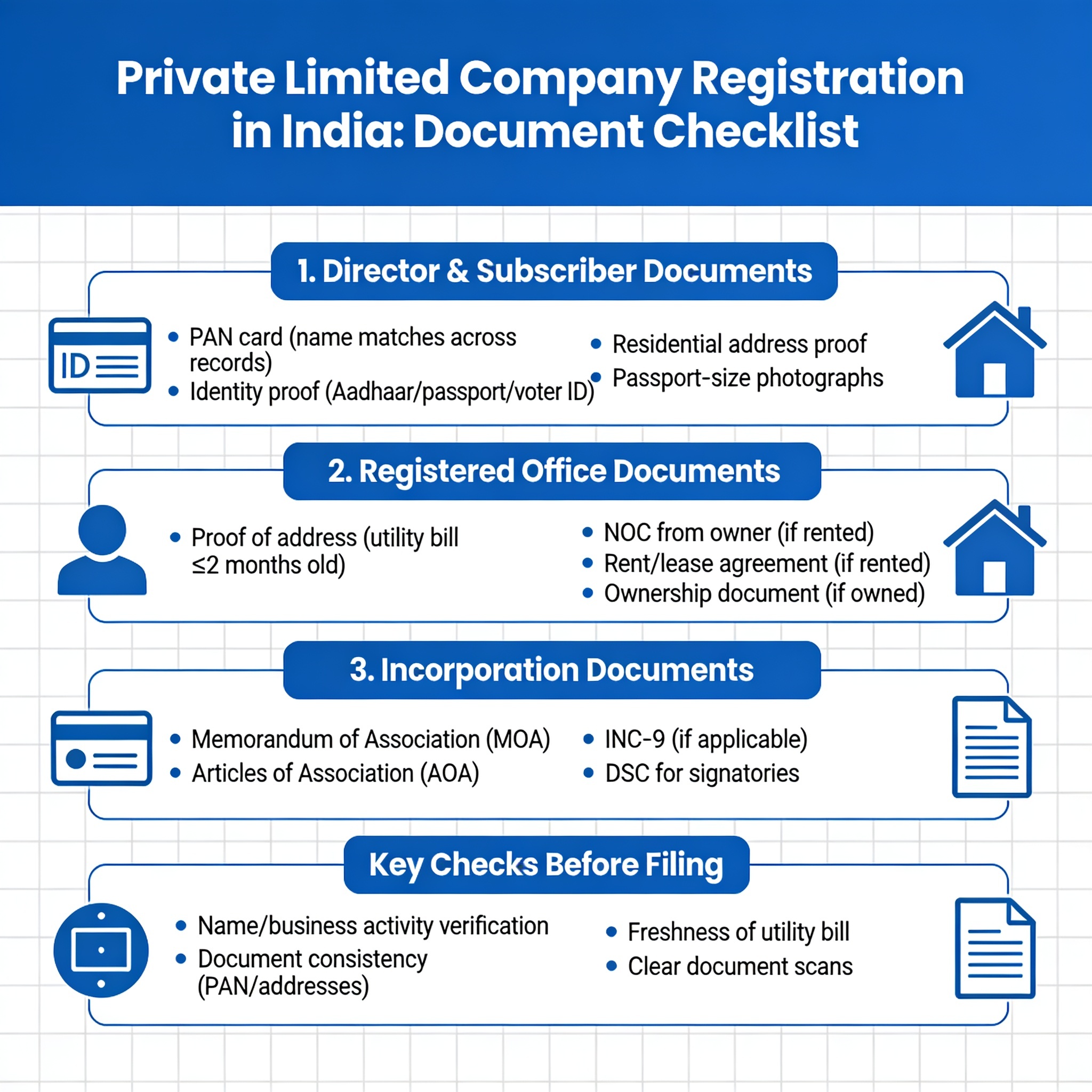
The documents required for company registration generally include identity and address proofs of subscribers/directors, PAN, photographs, registered-office proof, utility bill, owner NOC where applicable, and incorporation documents such as the MOA and AOA. The exact documents can change based on whether the directors are Indian or foreign nationals, whether the registered office is owned or rented, and the proposed company's structure. MCA's SPICe+ guidance should be checked for the current filing requirements.
What documents are required for Private Limited Company registration in India?
For a standard Indian-owned Private Limited Company, you should prepare documents for the proposed directors and subscribers, the registered office, and the company itself. Keeping these documents consistent before filing reduces the chances of resubmission.
A subscriber is a person agreeing to take shares in the proposed company. A director is the individual appointed to manage the company's affairs. In a small startup, the same person can be both a subscriber and director, so their KYC documents may serve both purposes.
1. PAN card of directors and subscribers
For Indian directors and subscribers, PAN is a key identification document used during incorporation. The name and other particulars entered in SPICe+ should match the supporting records.
Don't treat spelling differences casually. A mismatch between PAN, identity proof and the incorporation application can create avoidable clarification or resubmission work.
2. Identity and residential address proof
You should keep valid identity and residential-address documents ready for the proposed directors and subscribers, particularly where DIN or PAN-related requirements make supporting proof necessary.
Depending on the applicant and circumstances, documents may include Aadhaar, passport, voter ID, driving licence or other accepted proof. MCA specifically requires identity and residential-address proof in certain SPICe+ situations, including where a subscriber or director does not have a DIN.
3. Passport-size photographs
Recent passport-size photographs may be required as part of the KYC/documentation package prepared for incorporation. Keep a clear digital copy available rather than photographing an old printed picture at the last minute.
For practical filing work, consistency matters more than quantity. Use clear scans or images and make sure the person's name and supporting details remain easy to verify.
What documents are needed for the registered office?
The registered office is one of the most common areas where incorporation applications run into documentation problems. You need proof that the proposed company has the right to use the address and supporting evidence for that premises.
MCA's SPICe+ instructions state that where the correspondence address is also the registered office, proof of office address and a utility bill not older than two months are attached. The MCA FAQ also refers to an NOC from the owner where the premises are being used for the proposed company's registered office.
If you own the property
Keep the applicable ownership or possession document, the recent utility bill and the relevant address details ready. The exact supporting document can depend on the property and filing circumstances.
If you rent or use someone else's property
You will generally need the applicable rent/lease documentation and an NOC from the owner, along with the required utility-bill/address proof. The proposed company's address should match across the documents.
This is a practical judgement call worth making early: don't select a registered office simply because the address is convenient. Select an address for which you can obtain clean documentary evidence from the owner. MCA specifically warns against mismatches and missing NOC/lease/rent documentation.
Which incorporation documents are required under SPICe+?
SPICe+ is the MCA's electronic incorporation framework used for company incorporation. The supporting documents depend on the company's circumstances, but the core incorporation set commonly includes the MOA, AOA and declarations prescribed by MCA.
The Memorandum of Association (MOA) sets out the company's constitutional framework and objects. The Articles of Association (AOA) contain the rules governing the company's internal management.
MCA's SPICe+ FAQs list MOA, AOA, declarations by first directors/subscribers, registered-office proof, utility bills and identity/address proofs among the documents associated with incorporation.
For eligible standard incorporations, INC-9 is generated electronically. MCA states that different treatment applies where the number of directors/subscribers exceeds specified limits or where applicable DIN/PAN conditions are not met.
You should therefore avoid downloading random incorporation-document templates from third-party websites and assuming every form applies to your company.
What additional documents may be required in special cases?
Not every Private Limited Company has the same document checklist. Additional documents can arise because of foreign shareholders, corporate subscribers, special company types or specific incorporation structures.
For example, MCA's SPICe+ instructions require a copy of the certificate of incorporation and relevant resolution where a foreign body corporate is a subscriber. A promoter company may also need to provide a resolution.
Foreign directors and subscribers can also have additional authentication and documentation requirements. Section 8 companies, OPCs and other special cases have their own additional documents.
This is where using a generic pvt ltd registration documents list can be misleading. A checklist copied from another founder's incorporation may be incomplete for your case.
What should you check before submitting company registration documents?
Before filing, compare every document against the information that will appear in the incorporation application. The objective isn't simply to collect documents. It's to make sure the entire document set tells the same story.
Use this quick company incorporation checklist India:
-
Confirm the proposed company name and business activity.
-
Verify the names of all subscribers and proposed directors.
-
Match PAN and identity details exactly.
-
Check residential addresses against the supporting documents.
-
Confirm the registered-office address and PIN code.
-
Obtain the applicable utility bill and owner NOC.
-
Prepare MOA and AOA based on the proposed business structure.
-
Confirm DSC and MCA filing requirements.
-
Check whether any foreign, corporate or special-category documents apply.
-
Review every attachment for clarity before submission.
One of the most useful checks is surprisingly simple: open every PDF before uploading it. MCA's FAQs specifically identify illegible attachments, incorrect information and missing supporting documents as reasons an incorporation application can face problems or rejection/resubmission.
What are the most common mistakes in company registration documents?
The most common problems aren't usually complicated legal issues. They are small inconsistencies that become expensive once the application has already been submitted.
Typical examples include an address on the application that doesn't match the utility bill, an NOC that doesn't identify the proposed company correctly, an old address proof, unclear scans, incorrect nationality details, or missing identity proof where it is required.
MCA's own FAQ highlights several of these issues, including incomplete or mismatched registered-office information, missing NOC/lease documentation and illegible attachments.
A second judgement call is about document freshness. Don't wait until filing day to discover that the registered-office utility bill is outside the applicable period. MCA's SPICe+ instructions specify a utility bill not older than two months in the relevant registered-office situation.
What should you do after preparing the documents?
Once your documentation is ready, the next step is to validate the proposed structure, name, ownership and registered-office information before submitting the incorporation application. Filing should be treated as the final stage of preparation, not the first step.
If you want professional assistance with documentation and government approvals, Chandwani & Company's Private Limited Company registration service provides end-to-end support for company registration and other business structures.
If you're still deciding whether a Private Limited Company is the right structure, Chandwani's guide on Private Limited Company vs LLP vs Partnership Firm explains the ownership, funding, liability and compliance trade-offs before you commit to incorporation.
For an existing proprietorship, the documentation exercise can be different again. Chandwani's guide on converting a sole proprietorship to a Private Limited Company covers that route separately.
Final checklist before you file
Think of the process in this order: people → address → company documents → digital filing → verification.
First, get the KYC documents of every relevant director and subscriber in order. Next, finalise an address for which you can produce proper registered-office evidence. Then prepare the MOA, AOA and applicable declarations. Finally, compare the information across all documents before filing through the MCA system.
If you're missing one of these pieces, don't rush the application simply to get it submitted. A short documentation review before filing is usually easier than correcting an avoidable discrepancy after resubmission.
For founders who want the documentation, filing and government-approval process handled together, Chandwani & Company's Company Registration team can assist with the incorporation process.
FAQs
What are the basic documents required for company registration in India?
The basic documents generally include PAN and identity/address proof of the proposed directors and subscribers, photographs, registered-office proof, applicable utility bill and owner NOC, along with incorporation documents such as MOA and AOA. Additional documents may apply depending on the company's structure and the nationality or status of its subscribers and directors.
Is a bank statement required for Private Limited Company registration?
A bank statement can be accepted as an address-related document in applicable situations, but you shouldn't assume that one document works for every incorporation case. The acceptable proof depends on the applicant and filing circumstances. Check the current MCA requirements for the particular subscriber or director before finalising your document set.
How old can the registered-office utility bill be?
For the relevant SPICe+ registered-office situation, MCA's instruction kit specifies a utility bill that is not older than two months. The bill should also clearly support the address being provided in the incorporation application. Keeping a recent, legible bill ready is therefore advisable before filing.
Is an NOC required for a rented registered office?
An NOC from the property owner can be required when premises are being used as the proposed company's registered office, along with the applicable rent or lease documentation and utility bill. MCA's incorporation FAQ specifically identifies NOC and premises documentation as important registered-office attachments.
Are MOA and AOA mandatory for Private Limited Company registration?
MOA and AOA form the core constitutional documents of a company. Under the SPICe+ framework, electronic versions may be used where applicable, while certain circumstances require documents to be attached in the prescribed manner. The exact filing route depends on the subscribers and company structure.
Can I register a Private Limited Company without professional help?
Yes, incorporation is filed through the MCA system, and founders can prepare and submit their own application. However, professional assistance can be useful where there are multiple founders, foreign subscribers, corporate shareholders, complex registered-office arrangements or uncertainty around the applicable documents. The key is accurate preparation rather than simply having more paperwork.
Have Questions? We're Here to Help
Get expert advice from Chandwani & Company Chartered Accountants in Bhopal. Reach out to discuss your requirements.